
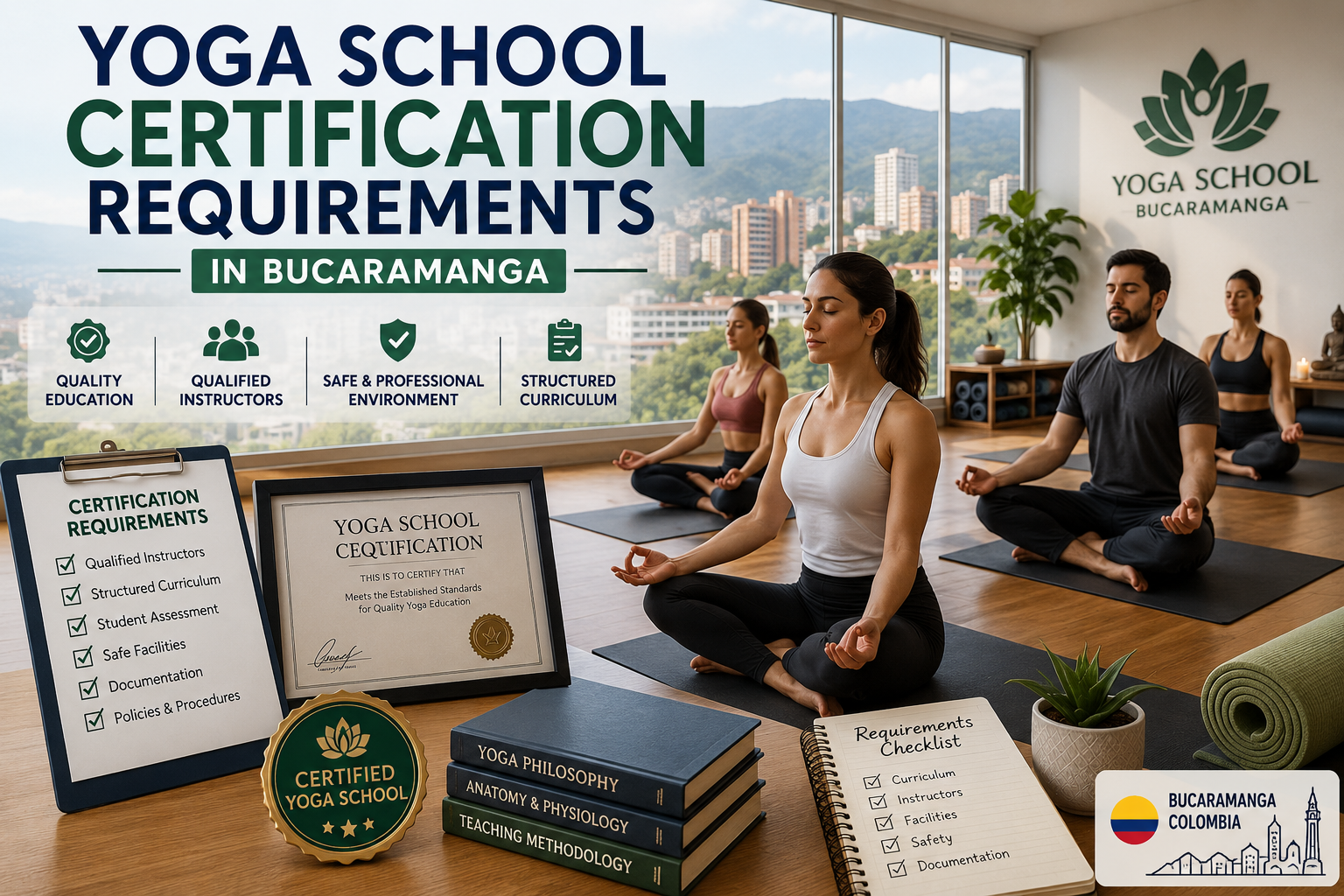
Yoga is becoming increasingly well-known in Colombian cities, including Bucaramanga, developing greater interest in established and credible yoga schooling. For a yoga faculty, obtaining certification can show that its instructional framework, teachers, centers, documentation, and operational practices meet defined expert requirements. Understanding the Yoga School Certification Requirements in Bucaramanga is consequently an important first step for colleges seeking to establish credibility and build trust with college students and instructors.
Yoga school certification generally includes more than completing a registration form. A university may also want to demonstrate licensed coaching staff, a proper curriculum, strong student support services, clear administrative procedures, and evidence that its education programme is updated continuously. Requirements can vary depending on the certifying business enterprise and certification standards, so schools must constantly evaluate the specific requirements before beginning an application.
What Are the Yoga School Certification Requirements in Bucaramanga?
The Yoga School Certification Requirements in Bucaramanga commonly focus on whether or not a university has an organised educational structure and the assets essential to provide accountable yoga education. Important areas can encompass curriculum layout, instructor qualifications, coaching method, student evaluation, facilities, safety techniques, college documentation, and administrative transparency.
Certification requirements are determined by the resources of the organisation imparting the credential, which means applicants ought to confirm the current requirements directly with that organisation instead of relying on outdated assumptions. A school ought to additionally be organized to provide supporting documentation demonstrating that its stated practices are truly implemented. Preparing those documents earlier has to make the certification way more organised and less difficult to manipulate.
Key Areas Schools Should Prepare
-
Qualified Teaching Faculty: Schools want to keep records demonstrating the training, education, relevant experience, and professional qualifications of instructors responsible for delivering yoga programmes.
-
Structured Yoga Curriculum: A certification software program should typically be supported by a properly organised curriculum covering suitable yoga principles and exercises.
-
Student Assessment: Schools have to have a low-cost method for assessing whether or not students have understood the specified theoretical and practical material.
-
Appropriate Facilities: The school wants to provide appropriate surroundings for yoga training, with enough space, ventilation, lighting, cleanliness, and suitable equipment.
-
Administrative Documentation: Accurate records help show that the college has a long-running operation.
-
Health and Safety Practices: An accountable yoga school must have strategies for preserving a safe, clean environment.
How Can a Yoga School in Bucaramanga Prepare for Certification?
Preparing for Yoga School Certification Requirements in Bucaramanga must begin with an internal evaluation of the application itself. School administrators can examine their present academic and operational practices in comparison to the standards of the selected certification corporation. This allows them to identify missing documentation, curriculum gaps, trainer needs, facility improvements, or administrative weaknesses before filing for certification.
An instruction checklist can also save you from leaving essential records out. The college wants to organise proof logically. Creating separate files for college qualifications, curriculum subjects, student regulations, facility records, evaluation techniques, and administrative files may additionally make the evaluation process more efficient.
Schools need to make sure that information is correct and consistent throughout files. If numerous teachers teach the same programme, their roles and responsibilities should furthermore be documented in order that the certification company can recognize how the programme is controlled.
Practical Preparation Steps
-
Review Certification Standards: Begin by reading the ideal requirements published using the chosen certification framework. Do not rely on requirements from other agencies or countries; study the chosen certification.
-
Audit the Curriculum: Examine every course module and pick out learning objectives, teaching hours, practical activities, theoretical subjects, and assessment techniques.
-
Verify Instructor Records: Collect copies or data of applicable trainer training, yoga education, relevant experience, and professional development.
-
Inspect the Training Facility: Evaluate the studio for cleanliness, accessibility, airflow, lights, adequate space, gadgets, and overall suitability.
-
Organise Student Documentation: Establish regular structures for enrollment, attendance, tests, student improvement, and completion records.
-
Create a Compliance Checklist: Assign responsibility for every requirement to a member of the college institution. A checklist can help directors organize completed files, a terrific undertaking.
Which Documents Are Needed for Yoga School Certification in Bucaramanga?
Documentation is a critical part of the Yoga School Certification Requirements in Bucaramanga because certification corporations want evidence that a college meets the relevant requirements. Exact necessities vary; however, colleges generally need to provide information about the business enterprise, its training group, curriculum, facilities, publications, and administrative strategies.
Documents have to be complete, accurate, legible, and consistent with the facts provided within the software program application. Schools have to avoid preparing files at the ultimate minute. Some information, in particular teacher credentials, curriculum content, guidelines, and student documentation, can also require time to verify and organise.
Where files are issued in every one of a kind language, the certification agency may moreover have unique regulations regarding translations or supporting evidence. Applicants need to consequently confirm record requirements and everyday formats earlier than filing their application.
Common Documentation Categories
-
School Information: Basic statistics about the yoga business enterprise, its location, contact info, operating form, and educational sports activities can be required to establish the identity and purpose of the school.
-
Instructor Credentials: Copies or records of teacher certifications, relevant schooling, professional experience, and continuing training can showcase the qualifications of the instructor.
-
Course Curriculum: Schools need to put together clear syllabi describing topics, learning goals, course format, training hours, practical training, theoretical education, and assessment techniques.
-
Policies and Procedures: Student conduct, attendance, assessment, examination times, safety, and different operational guidelines can help show that the college has a consistent administrative framework.
-
Facility Information: Depending on the certification level, details about the studio, lecture rooms, tools, sanitation, safety arrangements, and learning environment may also need to be documented.
-
Student Records: Attendance registers, assessment records, complete documentation, and one kind of relevant student information can show that the school keeps an organised educational method.
Why Are Instructor Qualifications Important for Yoga School Certification?
Instructor qualifications are a high-quality consideration in yoga instructor education certification due to the fact that instructors directly impact the quality and safety of student training. A faculty must be able to show that their university offers suitable yoga schooling and practical training relevant to the courses they provide.
Certification organizations can also set specific expectations regarding education, experience, continuing training, or teaching competence. Qualified teachers also help faculty maintain consistency in their curriculum and review classroom delivery. A carefully designed syllabus has limited value if instructors aren’t properly prepared to teach its subjects.
Schools can strengthen their professional framework by maintaining up-to-date industry knowledge, defining teaching responsibilities, encouraging continuous learning, and regularly reviewing teaching quality.
Faculty Standards to Consider
-
Relevant Yoga Education: Instructors need to have suitable education within the regions they teach. Their schooling should fairly correspond with the volume and content of the university’s programme.
-
Teaching Experience: Practical teaching experience can demonstrate that a teacher is aware of the manner of teaching yoga standards successfully.
-
Subject Expertise: Teachers responsible for anatomy, philosophy, pranayama, meditation, or specific specialised subjects must possess an appropriate understanding of these areas.
-
Professional Development: Continuing education lets teachers keep developing their knowledge and coaching strategies. A university can encourage workshops, advanced training, seminars, and highly relevant educational activities.
-
Ethical Teaching: Instructors need to understand ethical issues, respectful communication, student welfare, and accountable teaching practices.
-
Defined Responsibilities: Schools need to become aware of who teaches every route or module. Clear school duties make curriculum control and quality assurance much less complicated.
What Facilities and Safety Standards Should a Yoga School in Bucaramanga Maintain?
Suitable study surroundings are an important interest at the same time as evaluating Yoga School Certification Requirements in Bucaramanga. Yoga training includes physical exercise, so the schooling surroundings need to allow instructors to teach effectively and no longer use trouble. Schools need to ensure proper, sufficient floor space, air circulation, lighting, cleanliness, temperature, ventilation, accessibility, and safety standards.
The specific facility requirements depend on the certification body and the type of programme being offered. Safety needs to expand beyond the physical studio. Schools want to teach appropriate exercise guidelines to students and make certain teachers recognize how to provide responsible teaching.
Equipment ought to be maintained and used correctly, while emergency strategies should be in place through a well-trained staff. A professional yoga university has to maintain an environment wherein college students can ask questions, report concerns, and receive appropriate guidance.
Facility and Safety Priorities
-
Adequate Practice Space: Students must have sufficient room to perform moves without unnecessary contact with particular individuals or surrounding equipment.
-
Clean Environment: Floors, mats, props, toilets, and shared areas need to be maintained regularly. Good hygiene allows student comfort and contributes to a professional learning environment.
-
Ventilation and Lighting: Appropriate airflow and enough lighting fixtures can also make sensible and theoretical instructions extra comfortable. Facilities need to be reviewed frequently instead of waiting for an inspection.
-
Safe Equipment: Mats, blocks, straps, bolsters, and other props should be suitable for their intended use and maintained in good condition. Damaged equipment should be repaired or modified.
-
Emergency Preparedness: Schools should install suitable procedures for coping with emergencies. Staff must recognize how to respond and where relevant emergency information or equipment is located.
-
Student Safety Guidance: Students need to learn appropriate instructions regarding responsible exercise, use of the system, and communication with instructors about potential obstacles.
How Does Yoga School Certification Benefit Teachers and Students in Bucaramanga?
Yoga university certification can provide a framework for demonstrating academic and organisational credibility. For university students, a structured certification framework could make it much less complicated to recognize what a particular university offers and what requirements its programme is designed to satisfy.
For instructors, going for walks indoors at a professionally organised institution can be a useful resource for regular curriculum delivery, clearer responsibilities, and possibilities for expert development. Certification can also enhance the college’s recognition whilst speaking to the capability of college students, instructors, companions, or other participants of the yoga community.
However, certification should no longer be treated merely as a marketing label. Its value depends on the credibility of the certifying business enterprise and the faculty’s sustained commitment to maintaining the requirements related to its certification.
Potential Benefits of Certification
-
Greater Institutional Credibility: Certification can show that a university has undergone an organised evaluation against defined requirements.
-
Structured Education: Certification encourages faculties to formalize curriculum, teaching methods, assessments, and administrative structures.
-
Student Confidence: Students might also feel more confident selecting a university that, without a doubt, explains its instructional framework and expert requirements.
-
Professional Development: Certification requirements can also encourage instructors and directors to review their abilities and strategies regularly.
-
Quality Assurance: Formal requirements offer a reference point for which faculties can take a look at their instructional practices. Internal opinions can help raise awareness of areas requiring improvement.
-
Professional Recognition: Depending on the certifying organization and credential, certification can also help a college show its expert status within applicable yoga networks.
How Can Yoga Schools Maintain Certification Standards After Approval?
Meeting the Yoga School Certification Requirements in Bucaramanga should not be seen as a one-time administrative challenge. Once certification has been received, faculties should monitor the requirements that apply to them. Faculty qualifications, curriculum content, pupil records, centers, protection strategies, and administrative suggestions need to be reviewed periodically.
If the certification organization requires renewal or periodic reporting, the faculty want to keep a calendar to avoid missing critical deadlines. Continuous, strong control is likewise useful because of the reality that a college’s situations can change. New teachers can also be added, guides can be changed, centers can be accelerated, or new coaching materials may be delivered.
Any big change has to be evaluated in competition to the applicable certification standards. Maintaining organised information at a few stages during the year is typically less risky than attempting to recreate documentation swiftly in advance of renewal.
Long-Term Quality Practices
-
Conduct Regular Internal Audits: Periodic critiques can identify areas in which college practices no longer conform to certification requirements.
-
Update Faculty Records: Keep instructor qualifications and professional development statistics up to date. Record relevant new training and changes in coaching duties.
-
Review Course Content: Yoga education programmes ought to be reviewed periodically to make certain that curriculum content, learning objectives, and assessment methods continue to be suitable.
-
Maintain Student Records: Attendance, exams, completion records, and other required records need to be stored systematically.
-
Monitor Facilities: Regularly inspect studios, tools, sanitation arrangements, and safety techniques. Address safety issues right away rather than waiting for a certification exam.
-
Prepare for Renewal: If the credential has a renewal period, start training properly in advance. Review current requirements, update documentation, and remedy identified gaps before submitting renewal documents.
What Should Schools Consider Before Applying for Yoga Certification in Bucaramanga?
Before using it, a college needs to first determine whether or not certification is appropriate for its educational model and expert desires. The corporation needs to investigate the certification framework, recognize its requirements, confirm the scope of the credential, and determine whether or not the certification applies specifically to yoga schools and their educational programmes.
Schools ought to furthermore recognize the distinction between institutional certification and individual yoga trainer certification so that they pick out the precise pathway. Cost and administrative effort ought to moreover be considered, but these do not want to be the best selection factors.
A university ought to compare the transparency of the certification process, the credibility of the business enterprise, the clarity of its requirements, and the continuing obligations related to certification. Choosing a credential in reality due to the fact it’s far less expensive or easier to obtain won’t provide the expert price the college expects.
Important Questions Before Applying
1. Is the Certification Organisation Credible? Research the enterprise’s standards, records, certification framework, and expertise before submitting a software program application. Schools want to understand precisely what the credential represents.
2. Does the Credential Match the School? Confirm that the certification is designed for yoga facilities, not just individual teachers. The certification class wants to align with the group’s actual sports.
3. Are Requirements Clearly Defined? Schools should allow you to select what is required for curriculum, instructors, centers, documentation, and evaluation. Ambiguous requirements need to be clarified before selecting software.
4. Is the School Fully Prepared? Conduct an internal hole assessment before paying fees or submitting documents. Identify weaknesses and remedy them anywhere reasonably feasible.
5. What Are the Ongoing Obligations? Determine whether or not certification requires renewal, periodic reporting, continuing training, audits, or updated documentation. Understanding the obligations helps schools plan for long-term compliance.
6. Does Certification Support the School’s Goals? Consider how the credential suits the institution’s instructional challenge and expert development technique. Certification needs to contribute a high rate in terms of functioning clearly as a promotional label.
Get your internationally recognized yoga certification with authentic yoga standards in South America.
Conclusion
Understanding the Yoga School Certification Requirements in Bucaramanga allows faculties to treat certification as a holistic, first-rate, manipulative technique as opposed to merely a utility exercise. Qualified instructors, a complete curriculum, appropriate facilities, academic evaluation, safety procedures, and proper documentation all contribute to an expert academic environment. For a yoga university in Bucaramanga, careful education can make the certification process more effective and meaningful.
By reviewing requirements, establishing evidence, strengthening instructional approaches, and maintaining high quality after approval, schools can construct a stronger basis for long-term expert improvement. Ultimately, the most valuable certification is one that, as it ought to be, reflects the faculty’s academic best, professional practices, and ongoing strength of will to responsible yoga schooling.
Explore Our Recent Blogs
Frequently Asked Questions
1. What are the main Yoga School Certification Requirements in Bucaramanga?
The essential requirements can encompass certified instructors, an established curriculum, suitable centers, student assessment strategies, safety practices, and organised administrative documentation. Exact requirements depend on the certification body and the specific certification level. Schools need to continuously verify the present-day requirements without delay with the organization supplying the certification.
2. Does a yoga school need qualified instructors for certification?
Qualified instructors are typically a critical part of a credible yoga college certification framework. Schools need to preserve proof of relevant trainer schooling, relevant experience, and professional improvement. The unique qualifications required can vary in line with the programme and certifying commercial organisation.
3. What documents should a yoga school prepare before applying?
Schools may also need institutional data, teacher credentials, course syllabi, curriculum details, policies, facility details, evaluation procedures, and student statistics. Documentation requirements vary, so candidates need to keep the valid checklist from their chosen certification organization. Preparing documents in advance can reduce delays and make the software program less complex to check.
4. Are facilities considered during yoga school certification?
Facilities can be a crucial part of the certification evaluation because college students need the proper environment for practical yoga education. Schools need to be aware of exercise areas, cleanliness, airflow, lighting, equipment, accessibility, and safety practices. The precise facility requirements rely upon the applicable certification framework.
5. Can certification improve the credibility of a yoga school in Bucaramanga?
Certification can help demonstrate that a college has organised its academic and operational practices around the described requirements. It can also provide extra self-assurance to college students, teachers, and professional partners. However, colleges have to talk about the scope of their certification effectively and avoid making claims that the credential does not support.
6. How can a certified yoga school maintain its standards?
A licensed yoga school needs to regularly evaluate its curriculum, teacher qualifications, facilities, student records, safety measures, and administrative procedures. It wants to show any renewal or continuing compliance requirements set up with the resources of the certification enterprise. Regular internal reviews make it much less complicated to discover and deal with issues in advance than they have an effect on certification recognition.