
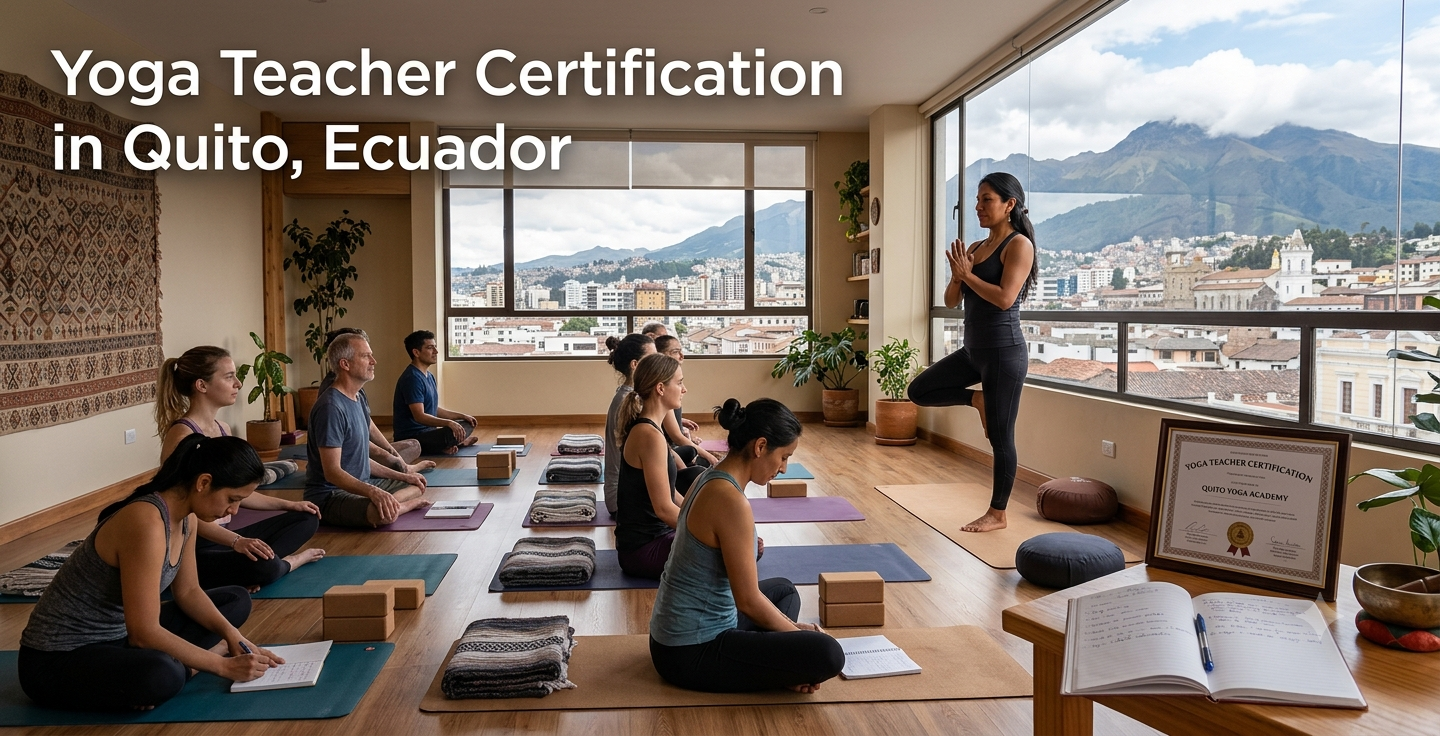
Yoga is becoming an increasingly well-known form of exercise in Ecuador, and Quito offers an exciting environment for folks who want to expand their practice and emerge as licensed teachers. If you’re thinking about the way to get yoga trainer certification in Quito, Ecuador, the process generally starts with selecting a suitable yoga teacher training programme, examining its curriculum, completing the desired education hours, and receiving a certificate.
For beginners, learning how to get yoga instructor certification in Quito, Ecuador isn’t always as simple as attending yoga classes. A professional yoga instructor schooling programme usually combines practical yoga techniques with anatomy, teaching techniques, philosophy, ethics, sequencing, conversation, and supervised practice. The unique form varies amongst schools, so college students should have a look at the curriculum and certification pathway carefully before enrolling.
What Is the Process for Getting Yoga Teacher Certification in Quito, Ecuador?
Understanding how to get yoga instructor certification in Quito, Ecuador becomes much less complex when the process is cut up into smooth steps. A potential student generally starts by defining their goals, discovering teacher training schools, comparing course structures, checking instructor qualifications, reviewing costs and schedules, and confirming what certificates may be issued upon successful completion. This education helps prevent confusion between a massive yoga path certificate and a credential related to a particular registration company.
The next step is finishing the chosen yoga trainer training programme. Depending on the programme, students may also have to study yoga philosophy, anatomy and physiology, asana techniques, pranayama, meditation, teaching methods, sequencing, professional ethics, and practicum. Students need to additionally check attendance regulations, assignments, realistic tests, and educational requirements before enrolment. For a Yoga Alliance pathway, the education has to be supplied through the correct Certified Yoga School credential, and the finishing touch certificate needs to meet Yoga Alliance requirements.
Key Steps to Follow
-
Define Your Teaching Goal: Decide whether or not you want to train in yoga education, specialise in a particular place, or build a stronger foundation for advanced training.
-
Research Quito Training Schools: Compare yoga teacher training programs in Quito through curriculum, faculty experience, schedule, reasonable training, student support, and certification pathway.
-
Check the Training Credential: Yoga Alliance keeps requirements for CYS programmes and gives statistics on its credential options.
-
Complete the Required Training: Attend the desired instructional classes, complete assignments, participate in sensible sports activities, and meet the completion requirements.
-
Complete Practical Teaching: This offers students the possibility to practice giving commands, demonstrating techniques, coping with a class, and speaking effectively with students.
-
Receive Your Certificate: For a CYT certificate, Yoga Alliance requires documentation displaying successful completion of the quality CYT training programme.
What Qualifications Do You Need for Yoga Teacher Certification in Quito, Ecuador?
If you’re studying the manner to get yoga trainer certification in Quito, Ecuador as an amateur, you may be worried about what years of yoga experience are required in advance of becoming a member of a trainer training programme. Entry requirements vary with the resources, so there can be no single admission requirement that applies to each programme in Quito. Some beginner-level programmes may additionally be offered to students who have completed a regular private course, while advanced programmes may additionally require prior training or educational experience.
Before enrolling, ask about the minimum age, previous yoga experience, physical requirements, language of instruction, attendance expectations, and any prerequisite qualifications. A valid programme must, in truth, provide a reason behind what students are expected to recognize before starting. It is also beneficial to differentiate between admission requirements and certification requirements because finishing a course does not automatically imply that every outdoor registration or professional requirement has been fulfilled.
Important Qualifications and Preparation
-
Regular Yoga Practice: A consistent personal yoga practice will help you understand simple postures, respiratory techniques, transitions, and aware movement before starting instructor training.
-
Basic Physical Awareness: You need to understand your own physical obstacles and be organized to analyze effective methods of working towards and understanding yoga.
-
Interest in Yoga Philosophy: An interest in yoga philosophy, meditation, ethics, and the wider traditions of yoga should make the learning experience more meaningful.
-
Commitment to Study: Students may also want to study anatomy, teaching technique, sequencing, philosophy, and wonderful topics outside normal exercise instructions.
-
Communication Skills: Confidence can expand over the course of training, so novices do not always want to be skilled public speakers.
-
Willingness to Complete Assessments: Schools may additionally use assignments, practical demonstrations, written papers, attendance requirements, or training assessments.
Take the Next Step in Your Yoga Journey with YAI South America
Whether you are a yoga teacher looking for professional certification or a yoga school seeking certification, YAI provides opportunities to support your professional journey and recognition. Choose the relevant application below to get started.
School: https://form.jotform.com/250402319636452
Teacher: https://form.jotform.com/250700797178464
How Many Hours of Yoga Teacher Training Are Required in Quito, Ecuador?
One of the most crucial questions when studying a way to get yoga instructor certification in Quito, Ecuador, is how many training hours are required. The answer is based entirely on the certification pathway decided on. Many internationally oriented novice programmes are primarily based around two hundred-hour yoga teacher training; at the same time, superior schooling may additionally incorporate three hundred-hour or 500-hour pathways. Yoga Alliance identifies CYT 200 as a credential related to finishing a 200-hour education registered with a Certified Yoga School.
Students should not expect that any course advertising and marketing “200 hours” automatically qualifies for every external credential. The curriculum, school registration, training modules, completion requirements, and certificate documentation count. Yoga Alliance moreover states that hours from one-of-a-kind training tracks cannot in reality be blended to satisfy some other CYS track requirement.
Common Training Levels
-
200-Hour Training: This is usually used because it is the foundational degree for human beings starting expert yoga instructor schooling.
-
300-Hour Training: A 300-hour programme generally represents an advanced test for students who have already been given foundational instructor education.
-
500-Hour Pathway: A 500-hour pathway represents a larger stage of education. Yoga Alliance describes CYT 500 as a sophisticated credential related to finishing education.
-
Children’s Yoga Training: Yoga Alliance has a CCYT credential for instructors who complete the relevant children’s yoga education pathway.
-
Prenatal Yoga Training: Students interested in coaching prenatal yoga can discover specialised training designed for this population.
-
Continuing Education: Yoga teachers can continue growing their knowledge through further education and relevant specialized publications.
What Subjects Are Covered in Yoga Teacher Training in Quito?
A primary part of the process of getting yoga teacher certification in Quito, Ecuador, is understanding what you may have to study. A complete yoga teacher education programme normally combines theoretical education with practical study. The motive is to help students understand not only the simplest way to perform yoga techniques but also how to create, adapt, sequence, and teach them responsibly.
Exact curricula vary by agency, so students should request an in-depth syllabus before registering. For Yoga Alliance CYS programmes, curriculum requirements include regions together with strategies and training, education technique, anatomy, philosophy, expert essentials, and practicum. Current Yoga Alliance standards moreover specify requirements concerning lead trainers for CYS programmes.
Core Subjects Students May Study
-
Asana and Yoga Techniques: Students research foundational postures, alignment principles, transitions, modifications, and ways of demonstrating practices.
-
Anatomy and Physiology: Anatomy education allows future instructors to understand the body and recognize elements that can affect movement.
-
Pranayama: Breathing practices are generally included in yoga instructor education. Students study outstanding techniques, their traditional context, and suitable strategies for introducing them during training.
-
Meditation and Mindfulness: Training may also encompass meditation strategies and techniques for assisting students in developing greater awareness and rest.
-
Yoga Philosophy: Students can also discover foundational philosophical thoughts, traditional texts, ethics, and the historical development of yoga. This provides context beyond the bodily exercise.
-
Teaching Methodology: Future instructors learn how to form lessons, provide verbal commands, demonstrate actions, assess students, offer suitable adjustments, and manage the flow.
How Can You Choose a Yoga Teacher Training School in Quito?
Choosing the right university is a vital step in mastering how to get yoga teacher certification in Quito, Ecuador. Instead of focusing solely on the course fee or promotional language, evaluate the programme’s curriculum, school, practical coaching opportunities, class hours, evaluation approach, facility layout, student reviews, and certificate information. If you are inquisitive about an out-of-doors credential, verify the school’s popularity right now through the relevant organization.
For humans thinking about Yoga Alliance registration, it’s especially important to verify that the specific programme is registered in the location depending on a declaration that the college is “across the world identified.” Yoga Alliance explains that CYS registration relates to a college’s syllabus, running schedule, and college assembly requirements, and its directory may be used to analyze registered faculties.
Factors to Compare Before Enrolment
-
School Registration: Check whether or not the faculty holds the credential or registration relevant to your intended pathway. Verify the appropriate training designation in place of relying on contemporary popularity claims.
-
Lead Trainer Qualifications: Current Yoga Alliance requirements specify Lead Trainer requirements for CYS 200 and other CYS programmes.
-
Curriculum Structure: Request an intensive breakdown of topics and educational hours. A clean curriculum makes it much less complex to understand what your education covers.
-
Practical Teaching: Find out how much supervised coaching and practice is provided. Practical experience lets you develop voice projection, sequencing, assertion, demonstrations, and classroom management.
-
Certificate Details: Ask what certificates you could collect after the entirety and whether or not it allows the outside registration you’re planning to pursue.
-
Student Support: Consider whether the school provides mentoring, feedback, study materials, practice opportunities, and guidance after graduation.
What Assessments Are Included in Yoga Teacher Certification in Quito?
If you want to understand the process to get yoga instructor certification in Quito, Ecuador, you need to study the tests before enrolling. An instructor training certificate is usually primarily based on completing the programme’s requirements, including attending classes. Depending on the college, tests can also encompass written assignments, practical demonstrations, teaching critiques, attendance, quizzes, displays, or supervised practicum.
For Yoga Alliance CYS programmes, schools are accountable for making sure trainees fulfill the obligations required for a successful education final touch in advance of issuing their certificates. Yoga Alliance particularly notes necessities, which include practicum, assignments, and competency requirements in its certificate standards.
Common Assessment Areas
-
Written Assignments: Students can be asked to offer a reason for yoga requirements, philosophy, anatomy, education standards, or elegance-making plan alternatives.
-
Practical Demonstration: A sensible assessment may additionally require students to demonstrate chosen yoga postures or techniques.
-
Teaching Practicum: Students can also teach elements or all of a yoga class under supervision. Feedback from instructors can assist in identifying areas requiring additional practice.
-
Class Sequencing: The evaluation can assess logical development, timing, transitions, modifications, and suitability for the intended students.
-
Attendance and Participation: Teacher training is extensive, so attendance and lively participation can be vital. Students have to understand the coverage for missed sessions before registering.
-
Final Evaluation: Students have to request information about grading and final assessment requirements so they understand how certification is decided.
What Can You Do After Getting Yoga Teacher Certification in Quito?
Understanding how to get yoga instructor certification in Quito, Ecuador is the simplest start to your professional improvement. After finishing training, graduates can also find opportunities to teach corporate clients, private groups, workshops, retreats, community programmes, fitness activities, or specialised yoga classes, depending on their education and the needs of the establishments in which they need to work.
A certificates does no longer routinely guarantee employment or permission to practise every form of regulated professional interest. Graduates have to check the requirements of male or female employers, studios, insurers, venues, and applicable government bodies. Ecuador’s Ministry of Labour and Human Development continues a country-wide extensive catalogue of expert qualifications and certification frameworks, so people pursuing a nearby expert pathway should research whether or not a particular hobby is protected and what requirements follow.
Potential Career Directions
-
Yoga Studio Instructor: Studios may additionally have their very personal requirements concerning enjoyment, elegance, fashion, coverage, and certification.
-
Private Yoga Teacher: Some teachers offer one-to-one sessions tailored to individual goals. Private training requires strong communication and the ability to tailor practices efficiently.
-
Corporate Wellness Instructor: Businesses may additionally organise yoga or movement instruction for personnel. Teachers interested in this field have to develop professional communication and planning skills.
-
Retreat Instructor: Yoga retreats can offer opportunities to train for large or specialised sessions. Teachers want to analyze the organiser’s needs before accepting an assignment.
-
Specialised Yoga Teaching: Additional education can help teachers broaden talents in areas that include children’s or prenatal yoga. Specialised credentials may additionally have separate requirements.
-
Further Yoga Education: Teachers can continue studying advanced technique, anatomy, philosophy, sequencing, and specialised coaching strategies.
Is Yoga Teacher Certification in Quito Worth Pursuing for Beginners?
For people looking to get yoga teacher certification in Quito, Ecuador, the cost of education depends largely on their personal and professional targets. Someone who desires to train in yoga can also benefit from a fully based training because, in reality, teacher education can provide a basis in exercise, anatomy, philosophy, coaching methods, sequencing, and professional responsibilities. It can also provide novices with supervised opportunities to broaden their coaching skills.
However, prospective students want to evaluate a programme based on its actual curriculum and credential pathway rather than assuming each certificate has the same expert fee. If worldwide registration is essential, verify the relevant business agency’s current requirements before enrolling. Yoga Alliance, for instance, calls for CYT applicants to provide proof of successful completion of training from a Certified Yoga School and specifies statistics that ought to appear on the certificates.
Points Beginners Should Consider
-
Personal Interest: Decide whether or not you need training, usually for private development, or whether or not your purpose is to train professionally.
-
Training Quality: Look past the number of hours and take a look at the curriculum, instructors, practical experience, evaluation techniques, and scholar assistance.
-
Certification Pathway: Confirm precisely what credential the programme awards. A certificate and an outside expert registration aren’t necessarily the same thing.
-
Financial Commitment: Compare training, study materials, exam or evaluation costs, travel, inns if relevant, and any separate registration fees.
-
Teaching Goals: Think about who you could ultimately need to educate. Different studios, employers, worldwide locations, and specialised settings may additionally have particular expectations.
-
Long-Term Learning: Yoga coaching involves continued training and expert development. Completing initial training can be considered the foundation for further study in the area of yoga.
Get your internationally recognized yoga certification with authentic yoga standards in South America.
Conclusion
Learning how to get yoga teacher certification in Quito, Ecuador consists of more than locating a direction and completing a difficult and speedy range of hours. Prospective teachers ought to investigate the teaching faculty, review the curriculum, confirm instructor qualifications, understand practical and assessment requirements, and verify exactly what certificate they will acquire. A comprehensive programme can offer foundational knowledge in yoga strategies, anatomy, philosophy, training techniques, ethics, sequencing, and supervised training.
For university students thinking about a way to get yoga trainer certification in Quito, Ecuador via an internationally recognized pathway, checking the unique programme’s registration reputation is especially important. Yoga Alliance presently identifies CYT 200 as a foundational credential based totally on completing a 200-hour training with a CYS 200, while its steering additionally requires appropriate documentation from the Certified Yoga School.
Explore Our Recent Blogs
Frequently Asked Questions
1. How long does it take to get yoga teacher certification in Quito, Ecuador?
The length is based on the structure of the education programme. A 200-hour programme can be introduced intensively or unfold over numerous weeks or months. Before enrolling, check the school’s particular calendar, attendance requirements, and conditions of the course.
2. Can a beginner get yoga teacher certification in Quito?
Yes, some yoga teacher training programmes are designed for beginners or students with a long-term interest in yoga practice. Admission requirements vary among schools, so applicants have to take a look at previous relevant experience and physical or educational expectations before enrolling. A novice needs to choose a programme whose curriculum fits their current diploma.
3. Is a 200-hour yoga teacher training enough to become a yoga teacher?
A 200-hour education is typically used as a foundational trainer-schooling degree. Yoga Alliance states that the CYT 200 credential calls for the completion of a 200-hour education with a CYS 200. However, nearby employers and other companies may also have extra expectations, so university students want to test the requirements relevant to their intended coaching environment.
4. Does a Quito yoga certificate automatically give Yoga Alliance registration?
No. Completing a yoga path and obtaining a certificate does not, by itself, mean that someone automatically holds a CYT credential. Yoga Alliance calls for proof of successful completion of the final stage of education from a Certified Yoga School and has precise documentation requirements for CYT programs.
5. What should I check before joining a yoga teacher training programme in Quito?
Check the school’s curriculum, training hours, faculty qualifications, realistic teaching requirements, evaluation approach, certificate layout, expenses, schedule, and applicable registration recognition. If you need an internationally oriented credential, verify the programme right now with the employer offering that credential. This permits you to avoid deciding on a route based totally on promotional claims.
6. Can I teach internationally after completing yoga teacher training in Quito?
International training possibilities rely upon the USA, corporation, studio, insurance necessities, immigration policies, and the credential you preserve. A Yoga Alliance CYT credential can also provide a stated registration pathway within the Yoga Alliance system; however, it does not automatically satisfy each U.S.A.’s criminal or expert requirements. Always take a look at the rules of the holiday spot and the specific organisation or company in which you would love to teach.