
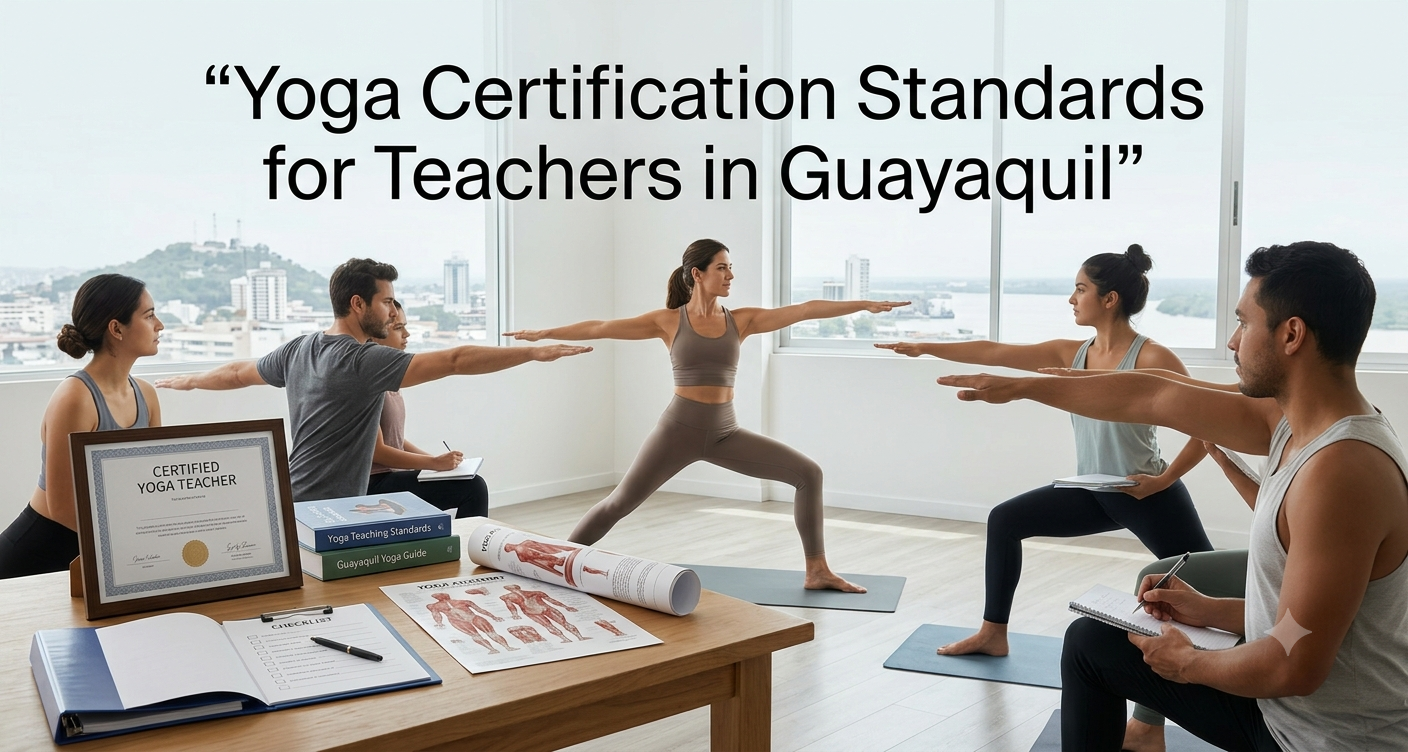
Yoga coaching is becoming more and more specialized, and university and college students in Guayaquil are paying more attention to teacher education, practical experience, safety, and recognized certification. For aspiring instructors, information on Yoga Certification Standards for Teachers in Guayaquil is vital because a certificate ought to reflect proper training rather than mere attendance at a brief course. A robust certification pathway usually combines sensible yoga techniques, teaching methodology, anatomy, philosophy, ethics, and supervised coaching.
In Guayaquil, teachers might also come across one in every type of certification business, yoga faculties, global networks, and training corporations. Therefore, applicants should carefully observe the curriculum, instructor qualifications, schooling hours, evaluation method, certification body, and continuing training expectations before choosing a programme. A professional certification ought to show that a trainer has advanced knowledge and practical competencies to teach college students responsibly and effectively.
What Are the Yoga Certification Standards for Teachers in Guayaquil?
Yoga Certification Standards for Teachers in Guayaquil typically speak to the academic, practical, moral, and expert criteria that a teacher needs to fulfill before presenting themselves as a licensed yoga trainer. Although certification requirements can vary among agencies, professional programmes usually look at understanding of yoga strategies, training ability, anatomy, philosophy, ethics, and pupil protection.
These areas help ensure that certification represents thorough expert education rather than a superficial course of study. For someone deciding on yoga instructor certification in Guayaquil, the call of the certificate needs to be the only hobby. Candidates need to inspect who issues the credential, whether or not the training company follows the described requirements, and what number of instructional hours are covered.
Whether or not education exercise is classified, and whether or not or no longer or not the certificate can be verified. A credible programme should provide a solid foundation that prepares instructors to work responsibly with students by focusing on completing a specific number of hours.
Which Areas Should a Yoga Certification Cover?
-
Yoga Techniques and Practice: Training needs to cover foundational practices, which include asana, pranayama, meditation, rest, and other suitable yoga techniques.
-
Teaching Methodology: An expert path must teach future teachers how to design classes, demonstrate postures, provide verbal cues, observe students, adapt practices, and speak clearly.
-
Anatomy and Physiology: Teachers want to expand a realistic understanding of the human body, movement, alignment, common barriers, and, number one, biomechanics.
-
Yoga Philosophy and Ethics: Certification should consist of knowledge of yoga philosophy, traditions, standards of living, and professional ethics.
-
Teaching Practicum: Students ought to have opportunities to teach, observe training, receive feedback, and enhance their learning.
-
Professional Responsibility: Teachers want to understand consent, respectful communication, inclusivity, privacy, appropriate boundaries, and the limits of their expert function.
How Many Hours Are Needed for Yoga Teacher Certification in Guayaquil?
One of the most common questions about Yoga Certification Standards for Teachers in Guayaquil concerns the range of schooling hours required. The answer depends on the organization issuing the certification and the level of credential being pursued. A 200-hour programme is generally used as a foundational trainer-schooling level, while better-diploma programmes may additionally involve 300, 500, or more hours.
However, capable instructors should avoid selecting a programme solely because it advertises a large range of hours. Training quality is primarily based on what those hours contain, the experience of instructors, the amount of supervised exercise, and how university or college students are evaluated. A properly designed hundred-hour yoga certification can offer a significant basis while its curriculum is complete and its practical components are nicely supervised.
What Should Training Hours Include?
-
Contact Learning: Classroom or in-person academic hours need to provide university students direct access to certified educators.
-
Personal Practice: Students need sufficient time to extend their very non-public asana, pranayama, meditation, and different practices.
-
Teaching Practice: Training must encompass opportunities to train actual sequences in place of depending absolutely on written assignments.
-
Independent Study: Reading, assignments, reflective paintings, anatomy tests, philosophy, and lesson planning can supplement in-room practice.
-
Assessment: A certification program must have a method for evaluating whether university students have achieved the expected abilities.
-
Progressive Development: Higher-level certification must constitute deeper records instead of simply repeating introductory material.
What Subjects Are Included in a Yoga Teacher Certification Curriculum?
A complete yoga trainer education framework must deal with more than one dimension of training instead of concentrating entirely on physical postures. Students preparing for expert work in Guayaquil ought to ideally have a foundation in yoga strategies, teaching techniques, anatomy and posture, philosophy, ethics, practicum, and professional responsibilities. This comprehensive curriculum permits instructors to broaden their personal knowledge and their potential to teach yoga effectively.
The curriculum needs to additionally help teachers recognize how to teach yoga effectively to one-of-a-kind university students. A teacher may moreover teach beginners, skilled practitioners, older adults, or college students with particular bodily skills. Certification will become more significant as it develops adaptable training skills in place of prescribing one rigid method for each student.
Core Curriculum Areas to Examine
-
Asana and Alignment: Students want to research foundational postures, sequencing thoughts, demonstrations, adjustments, and suitable alignment concerns.
-
Pranayama: Training ought to offer a background of respiratory strategies, their conventional context, appropriate instruction, and conditions where precise practices won’t be appropriate.
-
Meditation and Relaxation: Certification should introduce meditation techniques, attention practices, rest techniques, and methods of guiding college students through them.
-
Anatomy and Physiology: A useful anatomy module needs to be part of theoretical facts with actual yoga coaching.
-
Philosophy, History, and Lifestyle: Teachers benefit from studying the ancient and philosophical foundations of yoga. This permits them to speak about the broader context of yoga respectfully and successfully.
-
Teaching Methodology and Practicum: Students ought to research class planning, sequencing, observation, verbal cueing, demonstration, pupil communication, remarks, and supervised training.
How Can Teachers Demonstrate Competence and Safety in Guayaquil?
A yoga certificate should be supported by demonstrable competence. Teachers need training that allows them to offer a rationale behind practices genuinely, assess college students, offer guidance when appropriate, and recognize conditions that fall outside their professional scope. Certification should consequently encompass practical study and assessment instead of depending completely on theoretical examinations or attendance.
Safety, moreover, consists of the way teachers engage with university college students. Consent ought to be respected, specifically at the same time as bodily changes are involved. Teachers have to talk clearly and respectfully, even as they permit students to make informed selections about their very personal workout. Professional boundaries are an important part of growing a safe and simple yoga environment.
What Safety Standards Should a Certified Teacher Follow?
-
Know Your Scope: Teachers want to recognize what their certification permits them to train. Medical prognosis, remedy, or specialised professional services should not be supplied.
-
Use Informed Consent: Physical adjustments require clear and respectful verbal exchange. Students should usually feel able to decline an adjustment without stress or embarrassment.
-
Recognise Contraindications: Instructors should understand that certain postures, respiration-related conditions, or practices won’t be suitable for every student.
-
Maintain Professional Boundaries: Teacher-student relationships require appropriate communication and behavior. Professional obstacles help create a respectful environment wherein university students feel comfortable.
-
Create an Inclusive Environment: Classes need to accommodate differences in age, background, mobility, body type, and ability.
-
Refer When Necessary: When a student’s needs go beyond the teacher’s expertise, responsible instructors need to recommend the best certified professional.
Is a 200-Hour or 500-Hour Yoga Certification Better for Teachers in Guayaquil?
The choice between a 200-hour yoga certification and a 500-hour yoga certification is based on the teacher’s experience, career dreams, and desired level of expert development. A hundred-hour programme can provide foundational trainer education, while advanced schooling can be more appropriate for instructors who want to deepen their expertise or increase specialized knowledge.
A higher-hour certificate should not be mechanically interpreted as proof that one teacher is higher than any other. The quality of the curriculum, university education, practical relevance, assessment, ethics, and continuing development remains essential. Candidates in Guayaquil need to examine what each programme really teaches, as opposed to choosing a course truly because its advertised range of hours is greater.
Which Level May Suit Different Career Goals?
-
New Teachers: A foundational programme can assist novices in setting up basic facts in yoga practice, training technique, anatomy, philosophy, and class planning.
-
Experienced Instructors: Teachers who have already been given significant education experience might also benefit from superior training that addresses more complex topics.
-
Specialist Teachers: Instructors inquisitive about areas including children’s, prenatal, restorative, or healing procedures may want extra professional training.
-
Teacher Trainers: Those intending to educate future instructors require more robust venture understanding, education revelry, mentoring functionality, and expert credibility.
-
Studio Professionals: Teachers planning to work with yoga studios ought to research which credentials employers and clients value.
-
Long-Term Professionals: Teachers proceeding to build a sustained profession should keep in mind continuing training in the area of viewing the preliminary certificate as the very last degree of studying.
How Can Teachers Maintain Yoga Certification Standards After Qualification?
Meeting Yoga Certification Standards for Teachers in Guayaquil must be seen as an ongoing professional responsibility in the region, not a one-time achievement. Yoga schooling develops through practice, in addition to training, student feedback, workshops, mentorship, and continued study. Maintaining contemporary knowledge can also assist instructors in responding more effectively to evolving expectations around safety, inclusion, communication, and professional behavior.
Continuing training requirements vary between certification organizations, so instructors ought to check the rules of the organization that issued their credential. Keeping certificates, workshop information, training documentation, and proof of professional development can also make it less difficult to demonstrate ongoing dedication to expert mastery. Teachers need to frequently evaluate their qualifications and discover areas wherein additional training might also be needed to enhance their practice.
What Should Ongoing Professional Development Include?
-
Advanced Workshops: Teachers can attend workshops that deepen their knowledge of asana, pranayama, meditation, sequencing, or distinctive areas.
-
Anatomy Education: Continuing anatomy and biomechanics schooling can assist teachers in understanding movement patterns and making more informed teaching choices.
-
Teaching Practice: Regular schooling permits teachers to refine verbal exchange, sequencing, announcement, and classroom management.
-
Philosophy and Ethics: Continued observation of yoga philosophy and professional ethics can save you from turning your training into mechanical, primary phrases.
-
Specialty Education: Teachers can pursue extra training in suitable areas, which include children’s, prenatal, restorative, meditation, or extraordinary specialised yoga practices.
-
Documentation: Keeping information on workshops, publications, training received, and certificates makes expert development easier to demonstrate.
How to Choose a Yoga Certification Provider in Guayaquil?
Choosing an organization is one of the most crucial decisions when pursuing Yoga Certification Standards for Teachers in Guayaquil. Candidates ought to verify the provider within the scope of the credential and take a look at its posted requirements as opposed to relying completely on promotional claims. A reliable agency has to be clear about college qualifications, curriculum, training hours, assessment strategies, certification techniques, and expert expectations.
It is likewise crucial to differentiate between a college that offers training and an enterprise that independently certifies instructors or schools. Understanding this difference helps university students understand precisely what their certificates represent. Candidates want to ask questions before enrolling and request clear statistics about the qualification, assessment, training practicum, and any ongoing schooling expectations.
What Should Candidates Verify Before Enrolling?
-
Certification Organisation: Check the identification and reputation of the company issuing the credential. Look for clearly described requirements as opposed to relying on vague claims of being "global”.
-
Faculty Qualifications: Investigate the instructors’ yoga schooling, schooling level, specialisations, and professional information.
-
Curriculum: Request the entire syllabus and check whether or not it covers exercise, approach, anatomy, philosophy, ethics, and practicum.
-
Practical Teaching: Ask how mass-supervised training is conducted and the manner in which college students receive feedback. Practical competence has to be a vital part of teacher training.
-
Assessment Process: Understand whether or not university college students are assessed through practical demonstrations, examinations, assignments, interviews, or amazing strategies.
-
Certificate Verification: Find out whether or not certificates can be independently confirmed and whether the employer maintains appropriate certification records.
Why Do Certification Standards Matter for Yoga Teachers in Guayaquil?
Certification requirements matter because they establish a framework for expert education. When an instructor has completed training in yoga practice, anatomy, teaching methods, philosophy, ethics, and safe guidance, students have extra data on which to assess the instructor’s qualifications. Standards additionally encourage instructors to recognise their limitations and maintain appropriate professional boundaries.
For the Guayaquil yoga network, stronger professional education can guide safer and more consistent teaching without casting off the sort of yoga traditions. Certification does not replace personal experience, training capacity, or a teacher’s relationship with their way of life. Instead, a well-designed credential can provide proof that the instructor has completed the described academic requirements and is aware of the obligations associated with professional education.
How Can Standards Benefit Teachers and Students?
-
Greater Professional Credibility: A recognized certification can help teachers speak to their schooling and expertise to students, employers, and potential college students.
-
Improved Teaching Quality: Structured education develops skills in sequencing, communication, instruction, demonstration, and modeling.
-
Better Safety Awareness: Anatomy, frame structure, contraindications, consent, and scope of workout can assist instructors in making extra responsible choices.
-
Stronger Ethical Practice: Certification standards can boost professionalism, respectful behaviour, inclusion, and appropriate instructor-pupil obstacles.
-
Professional Development: Certification can establish a basis for ongoing learning and specialisation. Teachers can progressively enlarge their understanding as opposed to treating the number one qualification.
-
Student Confidence: Students are more likely to feel comfortable, as instructors can, in truth, deliver an explanation of their qualifications and expert limitations.
Get your internationally recognized yoga certification with authentic yoga standards in South America.
Conclusion
Understanding Yoga Certification Standards for Teachers in Guayaquil allows aspiring teachers to make informed decisions about their professional training. A sturdy certification pathway must go beyond a certificate of attendance and provide practical learning in yoga techniques, teaching methods, anatomy, philosophy, ethics, practical coaching, and safety. Candidates want to look at providers cautiously and verify who issues the credential.
For teachers already going for walks in Guayaquil, certification should be treated as a part of an ongoing expert adventure. Continued education, responsible schooling, practical experience, ethical behavior, and understanding the limits of one’s knowledge can make each person’s training career and the wider yoga network stronger. Ultimately, the most valuable certification is one supported by extensive training, clear standards, demonstrable competence, and a true commitment to student well-being.
Explore Our Recent Blogs
Frequently Asked Questions
1. What are the main Yoga Certification Standards for Teachers in Guayaquil?
The important requirements usually include yoga techniques, teaching techniques, anatomy and body shape, philosophy, ethics, realistic coaching, and professional responsibility. Exact requirements depend on the certification organisation. Candidates should therefore assess the specific requirements and curriculum of the organisation issuing the credential.
2. Is a 200-hour yoga certification enough to teach yoga in Guayaquil?
A two hundred-hour programme is typically used as foundational yoga instructor schooling; however, whether or not it is sufficient for a particular training opportunity relies upon the commercial enterprise, certification company, and form of education. Candidates want to verify the curriculum and sensible requirements in place of focusing most effectively on the hour-long format.
3. What should I study for yoga teacher certification in Guayaquil?
A complete programme should cover asana, pranayama, meditation, teaching approach, anatomy and form, yoga philosophy, ethics, sequencing, communication, and teaching practicum. These areas help college students build both theoretical knowledge and practical competence. Advanced or expert topics might also require extra training.
4. How can I verify whether a yoga certificate is credible?
Check who issued the certificate, whether or not the corporation publishes clear requirements, whether or not the schooling organisation follows those requirements, and whether or not the credential may be independently validated. You have to additionally evaluate university qualifications, curriculum, assessment strategies, and practical training necessities.
5. Do certified yoga teachers need continuing education?
Continuing education requirements depend on the certifying employer. Some corporations have specific professional development requirements, while others may also shape renewal in different ways. Teachers must assess the current guidelines of the certifying employer that issued their certificates and keep information on relevant professional development.
6. Why are ethics and safety included in yoga certification standards?
Yoga teachers are working right now with university and college students and therefore need to understand ethical boundaries, consent, respectful communication, inclusivity, and the limits of their competence. Ethical and safety training helps lessen inappropriate coaching practices and encourages accountable referrals, at the same time as university and college students require facts beyond yoga training.