
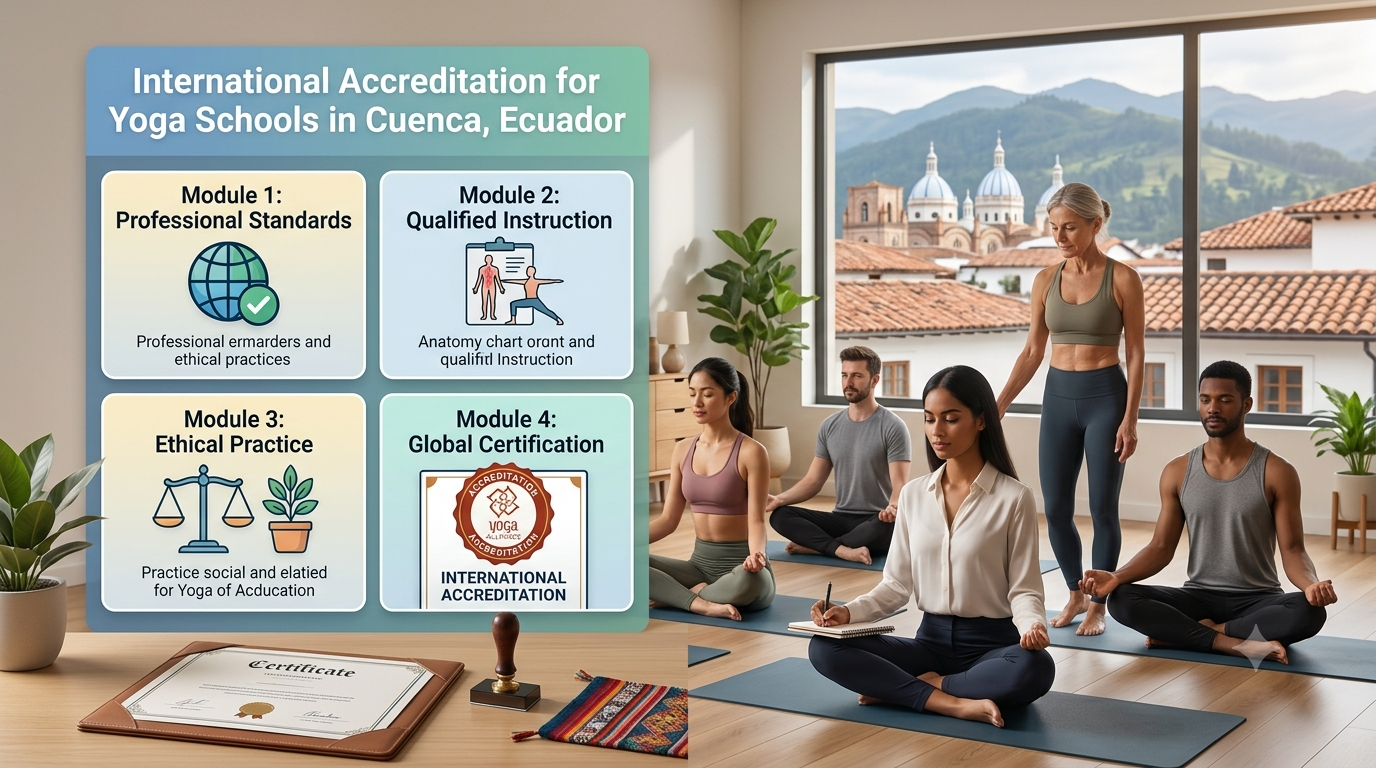
Yoga education is becoming more and more international, and yoga faculties in Cuenca are seeking procedures to demonstrate professionalism, quality, and credibility to the community and college students worldwide. International Accreditation for Yoga Schools in Cuenca, Ecuador, can offer a solid framework for demonstrating educational requirements and strengthening trust amongst college students, teachers, and expert partners.
It can also assist faculties to present their programmes more clearly whilst attracting inexperienced individuals from unique international places. Understanding these elements can help institutions choose a suitable recognition pathway and maintain academic standards. International Accreditation for Yoga Schools in Cuenca, Ecuador can therefore help expert improvement, clear education, and stronger credibility in the international yoga community.
What Is International Accreditation for Yoga Schools in Cuenca, Ecuador?
International accreditation for a yoga college typically refers to a proper method through which an agency evaluates a yoga institution against defined instructional, professional, administrative, or quality requirements. The unique thing is that accreditation standards vary between organisations, so yoga schools ought to generally check what the accrediting organisation actually evaluates and what the accreditation represents.
For a yoga school in Cuenca, worldwide accreditation can be mainly valuable when the employer wishes to demonstrate its credibility to college students from Ecuador and other countries. It can inspire colleges to preserve organised direction systems, certified instructors, apparent analyzing effects, appropriate assessment strategies, and professional documentation. International Accreditation for Yoga Schools in Cuenca, Ecuador must consequently be considered as a pleasing and credible framework instead of merely an advertising label.
Why Does International Recognition Matter for Yoga Schools?
International popularity could make it less difficult for college kids to understand the instructional requirements determined by a yoga corporation. Students increasingly compare yoga colleges based on curriculum, teacher credentials, certification pathways, quality of education, reviews, and instructor qualifications, rather than deciding solely on location or cost. A clear framework can provide more facts that permit prospective college students to compare a university option with a chunk of good fortune.
For colleges, global popularity may also assist expert positioning in a competitive marketplace. It can create a strong basis for developing trainer schooling programmes and communicating their educational approach to international audiences. However, colleges need to avoid suggesting that accreditation automatically offers licensing authority, college equivalency, immigration advantages, or prison authorisation to educate in a regulated career, unless the applicable authority specifically confirms this.
How Can a Yoga School in Cuenca Become Internationally Accredited?
A yoga college commonly begins offevolved offevolved with the aid of identifying the proper certification or accreditation agency and reviewing its eligibility requirements. The college may additionally need to offer statistics about its curriculum, teachers, training centers, course length, learning goals, student assessment techniques, administrative strategies, and ethical guidelines.
Documentation ought to be accurate, up-to-date, and consistent because the purpose of an accreditation procedure is to determine whether or not the institution can meet the accreditor’s stated requirements. The next stage may moreover incorporate software, report evaluation, assessment, or a one-of-a-kind form of assessment, depending on the company. Schools want to put together their programme data cautiously when choosing to treat accreditation as a smooth registration exercise.
For International Accreditation for Yoga Schools in Cuenca, Ecuador, instruction has to focus on demonstrating academic excellence, expert industry business practices, certified coaching personnel, clear techniques, and a determination to meet requirements after recognition is granted.
What Documents Should a Yoga School Prepare?
-
Curriculum Details: Provide a detailed curriculum outlining topics, learning goals, realistic schooling, teaching methods, and evaluation techniques used within the route of the program.
-
Teacher Qualifications: Maintain records of instructors’ yoga certifications, academic backgrounds, coaching level, specialized training, and applicable professional development.
-
Assessment Procedures: Clearly report examinations, realistic education critiques, assignments, attendance requirements, and precise strategies used to evaluate student competency.
-
School Policies: Include written guidelines protecting expert behavior, scholar protection, attendance, complaints, refunds, certification, and other important administrative policies.
-
Course Information: Keep accurate information about course length, schedules, contact hours, learning outcomes, practical requirements, and certification conditions.
-
Administrative Records: Maintain organised student statistics, instructor statistics, course documentation, certificates, and other applicable documents required for accreditation assessment.
What Standards Should an Internationally Accredited Yoga School Meet?
An internationally approved yoga faculty needs to have a clearly defined educational framework that explains what university college students are expected to study and how those results might be evaluated. Important areas can also include yoga philosophy, anatomy and body shape, teaching methods, meditation, breathing practices, practical teaching, ethics, sequencing, and professional development.
Another important interest is the consistency of schooling and evaluation. A college wants to explain who teaches each subject, teachers’ qualifications, how college students gain practical experience, and how competence is evaluated. International Accreditation for Yoga Schools in Cuenca, Ecuador, can be especially beneficial, as accreditation is supported by the resource of a truly superb management technique that is maintained at some point of the program in the area of simplicity in the direction of the initial software program.
Standards Should an Internationally Accredited Yoga School Meet
-
Comprehensive Curriculum: The program has to cover relevant areas, which consist of yoga philosophy, anatomy, meditation, pranayama, teaching methods, ethics, and practical yoga strategies.
-
Qualified Instructors: Teachers should possess suitable qualifications and relevant experience applicable to the subjects they teach.
-
Learning Outcomes: Each program needs to outline the knowledge, competencies, and teaching abilities university and college students are expected to develop.
-
Practical Training: Students want to gain sufficient opportunities for guidance, coaching, sequencing, conversation, demonstrations, and class control.
-
Student Assessment: Schools must use appropriate assessment techniques to decide whether or not university and college students have achieved the desired knowledge and skills.
-
Quality Improvement: The enterprise wants to frequently assess its curriculum, coaching techniques, teacher improvement, and pupil feedback to keep education excellent.
Why Is Teacher Qualification Important for Yoga School Accreditation?
Teacher qualifications are a crucial part of keeping education of high quality in a yoga university. Qualified teachers bring appropriate knowledge of yoga practices, philosophy, anatomy, teaching methods, and student safety to the classroom. When a university has well-informed instructors, university students are much more likely to gain established training and enhance their theoretical knowledge and practical training skills.
Teacher qualification is not limited to holding a yoga certificate. Relevant coaching experience, expert schooling, communication skills, practical knowledge, and ongoing professional development can also contribute to high-quality teaching. A properly organised yoga college must keep accurate records of instructor credentials and make sure that instructors are truly qualified for the subjects they teach.
Key Factors in Teacher Qualification
-
Relevant Yoga Training: Instructors should have appropriate yoga education and certification that suits the level and subjects they train.
-
Teaching Experience: Practical experience enables instructors to offer a variety of techniques effectively, manage instruction, and respond to one-of-a-kind student needs.
-
Subject Expertise: Teachers charged with regions that incorporate anatomy, philosophy, meditation, or pranayama want to have sufficient knowledge and education in those subjects.
-
Teaching Methodology: Qualified teachers must recognize lesson planning, sequencing, demonstrations, verbal exchange, remarks, and high-quality student feedback.
-
Professional Ethics: Teachers need to conform to appropriate professional behavior, maintain respectful relationships with university students, and promote a responsible learning environment.
-
Continuing Development: Regular workshops, advanced training, peer mentoring, and high-quality professional improvement courses can help teachers maintain and develop their expertise.
Continuing Professional Development for Yoga Teachers
Yoga schooling continues to adapt as teachers benefit from new data in areas that include anatomy, coaching methods, accessibility, meditation, and scholar well-being. Continuing professional improvement can help teachers preserve their skills after completing their initial instructor education. Schools can manage this via workshops, advanced training, peer learning, classroom observations, or appropriate instructional activities.
A culture of continuous learning additionally allows a yoga college to show that accreditation isn’t taken as a one-time achievement. Teachers who regularly update their knowledge can contribute to more effective programmes and more responsible teaching practices. For a college pursuing International Accreditation for Yoga Schools in Cuenca, Ecuador, ongoing professional development can consequently turn out to be part of a broader determination to educational excellence.
How Does International Accreditation Benefit Yoga Students in Cuenca?
International accreditation can supply yoga university college students in Cuenca more self-guarantee at the same time as deciding on a trainer training programme. A well-based accreditation framework can encourage faculties to maintain clear curricula, certified teachers, clear evaluation strategies, and documented educational requirements. For college students, this makes it less difficult to assess one-of-a-kind yoga instructor training programmes based on factors beyond course fees, location, or promotional claims.
For college students planning to pursue an expert yoga profession, a world-oriented certification pathway may additionally provide a clearer record of what their education includes and what their certificates represent. However, accreditation does not automatically guarantee employment, government recognition, or permission to teach overseas. Students should consequently verify the proper popularity and necessities related to the programme before enrolling.
Key Benefits for Students
-
Greater Transparency: Students can evaluate curriculum format, learning outcomes, education period, assessment strategies, and certification requirements before enrolling.
-
Qualified Instructors: Accreditation requirements can also encourage schools to maintain highly knowledgeable and skilled yoga teachers for particular areas of study.
-
Structured Learning: Students can benefit from organised training covering yoga philosophy, anatomy, pranayama, meditation, coaching approach, ethics, and practical training.
-
Professional Confidence: Completing a programme within a recognised educational framework can improve a student’s professional profile, even when presenting their training to studios or potential clients.
-
International Perspective: Students interested in training outside Ecuador can gain schooling within a framework designed to meet academic necessities extra genuinely at some point of distinct markets.
-
Better Learning Experience: Consistent assessment, organised learning materials, student guidelines, and instructor support can create a more effective and reliable educational environment.
How Accreditation Can Improve Student Experience
A properly accredited college can offer university students a clearer pathway from enrollment to graduation. Course schedules, attendance expectations, assignments, practical training requirements, examinations, and certification requirements should be communicated in advance of when university students choose a programme. Transparency reduces confusion and allows beginners to understand their obligations.
Accreditation-related requirements may additionally inspire faculties to improve their administrative structures. Students can benefit from better record-keeping, organised course materials, regular assessment, and clearer communication. These upgrades may furthermore enable students to gain advanced expertise earlier than college students while earning their yoga instructor certification.
What Is the Difference Between Yoga School Accreditation and Yoga Teacher Certification?
Yoga university accreditation and yoga trainer certification are related; however, they represent different stages of recognition in yoga training. School accreditation typically evaluates the organisation, its curriculum, teachers, coaching structures, evaluation strategies, and academic requirements. Yoga trainer certification, in evaluation, focuses on a man or woman who has finished a selected training programme and met the requirements set by the certifying corporation.
Understanding this difference is crucial for schools and aspiring teachers. A legal or state-approved yoga college may additionally offer trainer training programs under an established framework, while a character graduate can also obtain a certificate after completing the desired education and evaluation. Therefore, even as they are thinking about International Accreditation for Yoga Schools in Cuenca, Ecuador, colleges need to honestly offer a purpose in the back of whether or not or no longer their recognition applies to the organization, a specific program, or individual teacher certification.
Key Differences
-
Focus of Recognition: School accreditation evaluates the group and its educational framework, whilst trainer certification recognises a teacher’s training and competency.
-
Purpose: Accreditation helps display a university’s willpower to describe standards, at the same time as certification offers evidence that a teacher has completed a particular instructional pathway.
-
Evaluation: Schools can be evaluated on curriculum, faculty, centres, rules, and evaluation structures. Teachers are commonly evaluated through education, practical education, examinations, assignments, or specific competency requirements.
-
Who Receives Recognition: Accreditation is associated with the yoga school or programme, at the same time as certification is provided to male or female yoga instructors.
-
Professional Use: Accredited college recognition can deliver a boost to institutional credibility, and at the same time, trainer certification can help a person’s professional profile whilst searching for education opportunities.
-
Long-Term Requirements: Schools may also need to meet institutional necessities and entire renewal processes, while certified teachers can also want to continue with training or renewal, relying on the certifying organization.
Why Should Schools Explain Their Certification Clearly?
Clear communication protects the college and its students from misunderstandings. Marketing materials ought to pick out the agency issuing the certificates, provide a reason for what the programme covers, and keep away from unsupported claims about authorities’ reputation or expert licensing. Schools should moreover make it clear whether or not a certificate represents the final stage of education, a success assessment, institutional recognition, or some exclusive form of expert credential.
This transparency is especially essential when attracting international college students. Students can also come from around the world with one-of-a-kind expectations regarding schooling and professional qualifications. A sincere explanation of the certification pathway enables novices to make informed choices and decreases the danger of choosing a difficult or global yoga credential without a government-regulated qualification.
How Much Does International Accreditation for a Yoga School in Cuenca Cost?
The price of accreditation can range appreciably depending on the organization, accreditation class, programme level, number of programmes being evaluated, utility requirements, and administrative or assessment costs. Some businesses may also have separate prices for initial packages, institutional study, certification, renewal, or extra programmes. Consequently, there can be no regular fee that applies to every yoga university seeking out global recognition.
Schools need to evaluate the complete cost rather than focusing only on the initial fee. Administrative steering, curriculum development, teacher training, documentation, excellent management, and destiny renewal can also require time and financial resources. Before using International Accreditation for Yoga Schools in Cuenca, Ecuador, college owners need to request a current fee schedule and understand precisely what each rate covers.
Why Should Schools Consider Before Paying Accreditation Fees?
The first concern must be the credibility and transparency of the accrediting organization. Schools must look at its requirements, software, certification regulations, renewal necessities, and the statistics it gives publicly. They need to furthermore determine whether or not the popularity is in reality useful for their target college students and expert desires.
Schools want to avoid deciding on an enterprise completely, as it gives the lowest fee. A significant framework has to provide understandable requirements and an apparent method for evaluation. Comparing accreditation requirements, instructional benefits, administrative duties, and long-term fees can assist a Cuenca yoga faculty in making a more informed investment.
How Can International Accreditation Help a Yoga School Grow in Cuenca?
International accreditation can contribute to a school’s professional positioning by providing a useful framework for meeting academic standards. When supported by strong teaching, clear guidance, certified teachers, and a relevant curriculum, accreditation ought to make the university less complicated for prospective college students to assess. It may additionally help the university’s efforts to attract young people interested in the world-oriented yoga training.
Nevertheless, accreditation should not replace actual schooling or effective advertising and marketing. A university, even though it wishes for robust popularity, needs beneficial course content, materials, faculty support, clear communication, and a great learning environment. International Accreditation for Yoga Schools in Cuenca, Ecuador, is most valuable when it forms part of a broader method for sustainable educational excellence, rather than being handled as a standalone promotional tool.
International Accreditation Helps a Yoga School Grow in Cuenca
-
Builds Credibility: International reputation can help show that the college follows a described instructional and professional framework.
-
Attracts International Students: Clear requirements and recognized certification statistics can also help make programmes more attractive to green oldsters from specific global places.
-
Strengthens Professional Positioning: Accreditation can assist a yoga university to distinguish its instructional programmes in Cuenca’s competitive health marketplace.
-
Improves Educational Structure: Accreditation requirements can inspire faculties to develop clearer curricula, evaluation structures, trainer records, and administrative strategies.
-
Supports Consistency: Defined requirements can help ensure that students maintain a more consistent instructional experience throughout one-of-a-kind courses and instructors.
-
Encourages Continuous Development: Regular reviews and professional improvement can assist faculty in maintaining top-notch standards and adapting their programs over time.
Get your internationally recognized yoga certification with authentic yoga standards in South America.
Conclusion
International Accreditation for Yoga Schools in Cuenca, Ecuador, can provide a robust method for demonstrating academic excellence, expert instructors, and dedication to recognized standards. For yoga colleges, the way must encompass a lot more than obtaining certificates; it needs to encourage stronger curricula, licensed teachers, clear assessment, appropriate documentation, and continuous improvement.
Schools thinking about international popularity ought to cautiously compare accreditation companies and understand what every credential truly represents. They should keep away from unsupported claims and clearly distinguish institutional accreditation, programme popularity, and character yoga trainer certification. By combining clear requirements with quality education and responsible professional practices, yoga colleges in Cuenca can build greater credibility amongst local and international students.
Explore Our Recent Blogs
Frequently Asked Questions
1. What is International Accreditation for Yoga Schools in Cuenca, Ecuador?
International Accreditation for Yoga Schools in Cuenca, Ecuador refers to an institutional or program-level reputation-building technique based on requirements set by an accreditation or certification body; the actual requirements vary, which means they depend on the commercial enterprise offering the programme. Schools have to evaluate the particular requirements and benefits before making use of it.
2. Can a yoga school in Cuenca apply for international accreditation?
Yes, a yoga school can look at whether it meets the eligibility requirements of the relevant accreditation organization. Requirements can include curriculum, teacher qualifications, documentation, evaluation methods, centers, pointers, and administrative standards. The faculty want to verify the modern-day requirements straight away with the agency before starting the software program.
3. Does international yoga accreditation mean government approval?
Not constantly. International accreditation and authorities’ licensing or regulatory approval are particular necessities and do not routinely need to be handled as equivalent. Schools should make precise claims about their credentials and affirm any licensing or regulatory requirements relevant in Ecuador or some other U.S. country in which graduates intend to work.
4. What should students check before joining an accredited yoga school?
Students have to examine the company or corporation issuing the credential, the curriculum, instructor qualifications, program duration, evaluation strategies, and certification requirements. They also want to understand whether or not the credential is appropriate for their intended profession or similar training. Asking the college for clear documentation can help college students evaluate programmes more accurately.
5. Is international accreditation useful for yoga teachers who want to work abroad?
It can be useful as part of an instructor’s professional profile because it can showcase the finishing touch of a reputable yoga training programme. However, reputation differs among nations, employers, studios, and expert organizations. Teachers ought to check the unique necessities of the place and enterprise employer in which they intend to train as opposed to assuming that one certificate guarantees employment or criminal permission.
6. How can a Cuenca yoga school maintain its accreditation standards?
A college can maintain these requirements by regularly reviewing its curriculum, keeping trainer qualification records up to date, tracking student assessments, preserving appropriate guidelines, and supporting continuing professional development. It should also test the renewal or observe the implementation of tactics through its accreditation organization. Consistent, effective management is crucial for ensuring that the reputation stays strong through the years.