
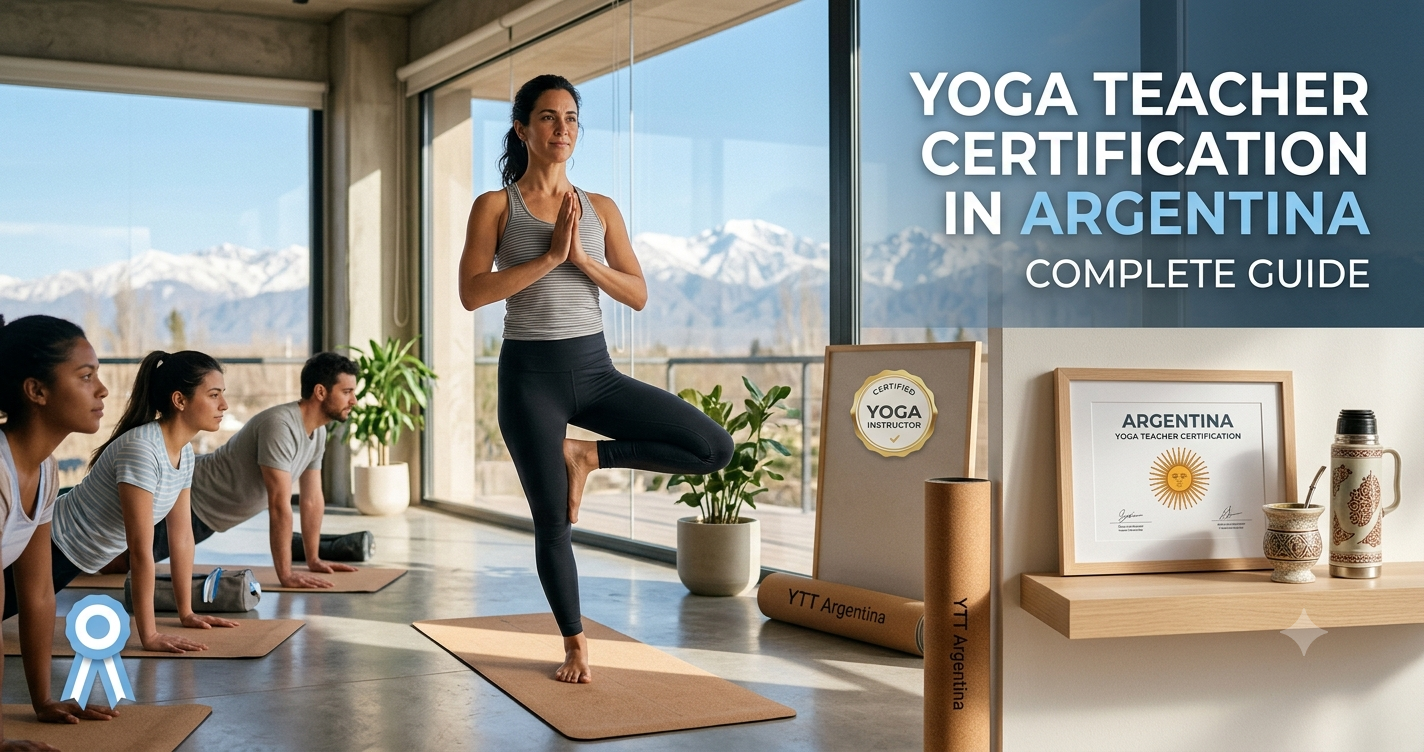
Yoga has emerged with an increasing number of famous experts and personal trainers in Argentina, developing possibilities for people interested in coaching yoga in studios, wellness centres, retreats, gyms, non-public settings, and online programmes. For aspiring instructors, acquiring an identified qualification can offer a solid foundation in yoga philosophy, anatomy, teaching approach, meditation, breathing techniques, and practical education. Understanding the certification process is consequently a crucial first step for all people planning a professional yoga career.
If you are wondering how to get yoga instructor certification in Argentina, the approach typically involves choosing a suitable certification programme, completing the preferred training hours, developing practical teaching skills, and receiving certification from a reputable yoga company or certification body. The exact requirements can vary depending on the organization, programme level, and intended coaching path. This manual explains the essential issues so you can make an informed choice before enrolling.
What Are the Requirements to Become a Certified Yoga Teacher in Argentina?
One of the primary questions aspiring instructors ask is what they need before beginning yoga teacher certification in Argentina. In many programmes, applicants no longer need to be advanced yoga practitioners or have prior coaching experience. However, a real hobby in yoga, regular private workouts, willingness to learn, and determination to finish the schooling are essential. Some advanced programmes can also require prior experience or an introductory qualification before admission.
A whole yoga trainer schooling path in Argentina typically combines theoretical training with practical mastery. Students may also study yoga philosophy, anatomy and body shape, asana strategies, pranayama, meditation, sequencing, teaching techniques, ethics, and studio management. Before selecting a programme, potential university college students need to carefully take a look at its curriculum, education hours, assessment methods, certification authority, and whether or not the qualification fits their professional dreams.
Key Requirements to Consider
-
Personal Yoga Practice: A regular yoga practice can help university students understand postures, alignment, breathing, attention, and the overall experience of working closer to yoga.
-
Training Hours: Certification programmes can range significantly in length and intensity. Check the total number of instructional hours, practical teaching hours, and what is required.
-
Yoga Anatomy Knowledge: Understanding primary anatomy and movement requirements is crucial for responsible training. A proper programme must provide a reason behind how postures have an impact on various factors of the body.
-
Teaching Methodology: Learning yoga is different from reading about how to teach yoga. Teacher education wants to cover verbal cues, demonstrations, sequencing, lesson planning, statements, remarks, and effective communication.
-
Yoga Philosophy and Ethics: Traditional yoga training extends past bodily postures. Philosophy, meditation, and ethical standards.
-
Assessment and Certification: Find out how university and college students are evaluated before choosing a programme. Assessments can also include written work, practical demonstrations, attendance requirements, and assignments.
How Long Does Yoga Teacher Certification Take in Argentina?
The duration of a yoga trainer certification in Argentina is based on the extent, curriculum, timetable, and company supplying the programme. Some short courses may be finished in a few weeks or months, while longer programmes may extend over a longer duration to allow college or university students to balance training with studies or other obligations. A longer programme isn’t automatically better; curriculum quality, practical experience, instructor credentials, and assessment requirements are also vital.
Students want to distinguish between the length of education and the overall learning experience. Becoming a confident yoga instructor calls for practicing outside formal classes, including private practice, class training, workshops, and personal study. For this reason, candidates ought to look not only at the advertised duration but also at the depth and structure of the education.
Factors That Affect Certification Duration
-
Certification Level: Entry-level instructor education typically requires a lot less study than higher-level programmes. More specialized or higher-degree certifications can also require extra anatomy, schooling, philosophy, and practical education.
-
Study Format: Full-time programmes can offer focused learning, while part-time programmes spread the course over a longer duration.
-
Number of Training Hours: The number of training hours is a crucial indicator of programme depth. Candidates need to compare curricula in the process of selecting a direction, primarily based on how quickly the certificates may be received.
-
Practical Teaching: Programmes that include supervised coaching exercises may additionally take longer; however, they can provide valuable learning.
-
Assessment Requirements: Assignments, examinations, education demonstrations, and other exams can affect completion time. Students need to understand all evaluation requirements before committing to a programme.
-
Personal Study Time: Reading, working through the curriculum, preparing sequences, analyzing anatomy, and completing assignments can add a lot of time beyond class sessions.
How Do You Choose the Best Yoga Teacher Training in Argentina?
Choosing a high-quality yoga teacher training in Argentina requires more than evaluating expenses or course durations. Prospective university college students want to assess the institution behind the certification, curriculum quality, coaching staff, practical components, assessment requirements, and the credibility of the qualification. A programme has to honestly supply an explanation for what college students will learn and what skills they’re expected to demonstrate before certification.
It is also critical not to forget your intended coaching environment. Someone planning to teach yoga may also want a specific learning path for someone interested in prenatal yoga, restorative packages, children’s yoga, meditation, or advanced practices. Choosing training based totally on your long-term objectives can prevent the need to repeat foundational training later.
What to Check Before Enrolling
-
Certification Organisation: Research the enterprise issuing the certificate and understand its certification requirements. Look for transparency about requirements, curriculum, assessment, renewal, and instructor expectations.
-
Course Curriculum: A sturdy curriculum has to cover more than physical postures. Look for yoga philosophy, anatomy, body shape, pranayama, meditation, coaching technique, sequencing, ethics, and sensible coaching.
-
Qualified Trainers: Investigate the records and experience of the teachers. Trainers need to exhibit suitable records of yoga exercise, training, anatomy, and student safety.
-
Practical Experience: Teaching exercise is one of the most valuable components of a trainer education programme. Students have to have opportunities to practice in real-world settings and receive positive feedback.
-
Student Support: Consider whether or not first-year students get access to mentoring, feedback, study resources, and guidance throughout the programme.
-
Professional Recognition: Determine how the certificates may be used professionally and whether or not they meet the expectations of studios, proper centers, employers, or establishments in which you suggest training.
Is Yoga Teacher Certification in Argentina Available Online?
Yes, aspiring teachers may also find online, in-person, and mixed approaches to yoga training, depending on the company and programme. Online yoga teacher education can be attractive to college and university students who have scheduling barriers or live far from major training centres. It can provide proper access to lectures, resources, demonstrations, assignments, and digital workout lessons without requiring university students to attend each session in person.
However, potential instructors need to check the practical component carefully. Yoga schooling is reasonably experiential, and college students gain from receiving comments on alignment, demonstrations, verbal cues, sequencing, and class pacing. If selecting a web certification programme, confirm how sensible coaching abilities are assessed and whether or not university students have tremendous opportunities to demonstrate their talents.
Advantages of Online Yoga Certification
-
Flexible Scheduling: Online programmes should make it much less difficult to balance work, family responsibilities, or other commitments. Students can frequently organise their study time around their modern-day timetable.
-
Accessible Learning: Digital programmes may additionally need to make education accessible to college students who no longer live close to an appropriate training centre.
-
Recorded Resources: Some online programmes offer recorded schooling or virtual resources that students can revisit. Reviewing complex anatomy, philosophy, or coaching standards can beef up understanding.
-
Blended Learning: A mixture of online theory and supervised practical exercises can provide flexibility while preserving essential hands-on factors.
-
Independent Practice: Online learning regularly encourages college and university students to increase self-discipline and build a regular study habit. These benefits can be achieved at the same time as transitioning into professional training.
-
Need for Careful Evaluation: Not every online programme offers the same educational quality. Students want to look into curriculum intensity, instructor qualifications, practical evaluation, student support, and certification requirements before enrolling.
What Does a Yoga Teacher Certification Programme in Argentina Teach?
A complete yoga certification programme should help university students develop from private practitioners to capable instructors. This way, reading is not only the simplest manner to carry out asanas; however, it is also a way to provide a reason for them, collect them efficiently, modify practices, talk truly, and create a safe studying environment. The programme needs to ideally combine traditional yoga data with cutting-edge instructional and anatomical information.
Students can count on numerous interconnected areas to observe. These generally include asana practice, pranayama, meditation, yoga philosophy, anatomy and frame shape, coaching methods, sequencing, ethics, and practical training. The stability of a few of the subjects can vary depending on the certification level and the business enterprise.
Core Areas of Yoga Teacher Training
-
Asana and Alignment: Students research the principles behind common yoga postures, which include alignment, changes, transitions, and appropriate instruction.
-
Pranayama: Breathing practices shape an essential part of many yoga traditions. Training can introduce one to a range of techniques, their traditional features, appropriate instructions, and issues for accountable teaching.
-
Meditation and Mindfulness: Teachers can also study foundational meditation techniques and techniques for incorporating interest or mindfulness into schooling. This expands yoga schooling past essentially a bodily workout.
-
Yoga Philosophy: Students discover philosophical standards and historic traditions that form the basis of yoga. Understanding those requirements can help instructors present yoga as a broader option in a region of tough and speedy physical sports activities.
-
Anatomy and Physiology: Basic know-how of the human frame allows instructors to recognize movement, alignment, boundaries, and adjustments. This understanding enables more secure and more knowledgeable preparation.
-
Teaching Methodology: Students learn sequencing, verbal cueing, demonstrations, assertion, beauty management, and lesson planning. These skills are crucial for translating non-public knowledge into powerful teaching.
How Much Does It Cost to Become a Certified Yoga Teacher in Argentina?
The cost of becoming a licensed yoga trainer in Argentina varies depending on the programme, certification diploma, training layout, location, teachers, protected assets, and regular curriculum. A much less steeply priced course can also appear appealing to begin with; however, college students must remember what is included within the price and whether or not the programme offers enough practical and academic schooling.
When comparing yoga instructor schooling fees, look past the headline rate. Check whether or not practical components, assessments, certification, practical periods, workshops, mentoring, and exceptional educational resources are covered. If you consider the full value upfront, you can avoid unexpected costs.
Costs You Should Compare
-
Course Tuition: This is usually the primary rate related to instructor training. Compare tuition with the number of instructional hours and the intensity of the curriculum, rather than searching for the lowest price on your own.
-
Study Materials: Some programmes include manuals, virtual assets, books, or recorded instructions, while others may require university college students to shop for those one after the other.
-
Assessment Fees: Certification or examination fees can also, once in a while, be free for classes. Confirm all evaluation-related expenses before registering for the programme.
-
Travel and Accommodation: Students attending an extensive programme outside their domestic city may also need to budget for travel and accommodation.
-
Specialisation Courses: Additional qualifications along with prenatal, children’s, restoration, or restorative yoga can also require separate schooling.
-
Value of Certification: The most inexpensive programme is not the most authentic cost choice. A well-set-up programme with skilled instructors, practical schooling, and credible evaluation.
Can International Yoga Certification Help You Teach Professionally in Argentina?
International yoga certification can be beneficial for teachers who want their qualifications to be understood beyond a single, local training environment. It may support career mobility, mainly for instructors interested in working with international college students, retreats, health groups, journey-primarily based programmes, or online novices. However, certification needs to be no longer seen as an automatic guarantee of employment.
Professional opportunities rely on numerous elements, including schooling potential, experience, communication competencies, specialisations, expert popularity, and the expectancies of individual employers or studios. A certificate affords an educational foundation, but successful teaching moreover requires ongoing learning and practical experience.
How Certification Can Support a Yoga Career
-
Professional Credibility: A proper certification can show that a teacher has completed established education and assessment.
-
International Opportunities: Teachers with internationally understood credentials can also find it less complicated to present their academic history abroad while exploring possibilities outside Argentina.
-
Online Teaching: Certification combined with strong communication and digital skills can assist with online yoga coaching. Teachers can probably teach college students from specific areas without being confined to a community studio.
-
Retreat Teaching: Yoga retreats can provide opportunities for skilled instructors to work with various companies. Training in sequencing, communication, meditation, and organizational control may be especially useful in retreat environments.
-
Wellness Industry: Certified instructors can also discover possibilities in gyms, well-being centres, hotels, motels, business enterprise well-being programmes, and network settings.
-
Continuing Professional Development: Certification needs to be considered as the beginning of professional improvement in the region of the save you.
How Can You Start a Yoga Teaching Career After Certification in Argentina?
After completing yoga teacher certification in Argentina, the next step is to apply theoretical expertise through regular training and practice. Newly licensed instructors can begin by working with friends, family, small businesses, community organizations, or through supervised training where appropriate. Regular education enables improved self-assurance, timing, communication, sequencing, presentation, and the ability to adapt training to all kinds of newcomers.
Building a sustainable career furthermore calls for professional presentation. An easy training profile, accurate certification statistics, a professional biography, elegant descriptions, portfolio materials, and a suitable online presence can help college students understand what you provide. Teachers want to preserve learning instead of depending completely on the knowledge acquired during preliminary certification.
Practical Steps After Certification
-
Build Teaching Experience: Start with simple poses and gradually increase your teaching responsibilities. Repeated practice will assist you to emerge as more confident and adaptable as an instructor.
-
Choose a Specialisation: Consider areas including restorative yoga, prenatal yoga, kids’ yoga, meditation, or yoga for specific populations. Specialisation can assist in differentiating your professional profile.
-
Create a Professional Profile: Prepare a concise biography that explains your education, teaching method, qualifications, and regions of interest. Keep all claims about certification accurate and verifiable.
-
Network Locally: Connect with yoga studios, wellness centres, retreat organisers, gyms, and distinguished professionals within the fitness community.
-
Develop Online Skills: An online presence can assist teachers in reaching potential college students beyond their current area.
-
Continue Your Education: Keep developing your knowledge through workshops, advanced courses, anatomy training, philosophy research, mentoring, and regular personal practice.
Get your internationally recognized yoga certification with authentic yoga standards in South America.
Conclusion
Learning a way to get yoga teacher certification in Argentina includes more than finishing a quick course and receiving a certificate. Aspiring teachers need to carefully study the certification provider, curriculum, schooling hours, practical training opportunities, assessment requirements, instructor qualifications, and the programme’s relevance. Choosing schooling based totally on remarkable and long-term goals can offer a far stronger foundation for training.
Whether you want to train in a local studio, lead private sessions, work at retreats, offer online training, or explore global opportunities, a properly designed yoga teacher certification in Argentina may be a crucial step toward professional development. The most effective method is to pick out a terrific programme, build a strong personal and educational practice, benefit from it regularly, and keep reading throughout your career.
Explore Our Recent Blogs
Frequently Asked Questions
1. How can I get yoga teacher certification in Argentina without previous teaching experience?
Many entry-stage programmes are designed for people who have not taught yoga before. Applicants generally benefit from having a sincere hobby in yoga and a willingness to commit to independent study and practice. Always check the man or woman programme’s admission requirements before enrolling.
2. What is the best yoga teacher certification in Argentina?
There isn’t always a single certification that is perfect for every student. The proper programme is based on your goals, desired coaching style, timetable, price range, curriculum requirements, suitable schooling, and the credibility of the agency issuing the certificates. Compare the factors cautiously before you decide.
3. Can I complete yoga teacher training in Argentina online?
Online and mixed yoga teacher training alternatives may be available, depending on the organisation and programme. Before enrolling, verify how sensible schooling, tests, feedback, and instructor interaction are handled. A programme with extensive, sensible assessment can provide more effective guidance for training.
4. How many hours are needed for yoga teacher certification in Argentina?
The variety of hours depends on the certification level and organization. Entry-level programmes, advanced certifications, and professional qualifications may require more hours. Always confirm the suitable educational, practical, evaluation, and impartial-test requirements of the programme you are considering.
5. Can an internationally certified yoga teacher work in Argentina?
An internationally issued yoga certificate can also help demonstrate formal schooling; however, expert requirements can vary among studios, employers, companies, and styles of practice. Teachers must verify what a particular enterprise, organisation, or professional setting expects. Certification is one part of professional education and does not, by itself, guarantee employment.
6. Is becoming a certified yoga teacher in Argentina worth it?
For people who in reality need to train yoga, a certification can offer valuable expertise in training technique, anatomy, philosophy, pranayama, meditation, sequencing, and professional practice. Its fee is based entirely on the quality and credibility of the training programme. Combining certification with sensible enjoyment and perseverance with schooling can provide a stronger basis for a long-term yoga coaching career.